The Parent’s Guide to Conservative Scoliosis Treatment: Bracing & Beyond
Learning that your child has scoliosis can leave you with many questions. Will the curve become worse? Does your child need to wear a brace? Can exercises correct the spine? And, perhaps most importantly, can treatment prevent the need for surgery?
The reassuring answer is that many adolescents with mild-to-moderate scoliosis can be managed without surgery, particularly when the condition is detected early and carefully monitored while the child is still growing.
The purpose of conservative scoliosis treatment in Dubai is not simply to improve posture. It is to monitor spinal growth, reduce the risk of curve progression, maintain strength and mobility, and help the child continue school, sports and everyday activities with confidence.
At Adam Vital Hospital, the treatment plan is personalised according to the child’s curve measurement, skeletal maturity, growth remaining, curve pattern and risk of progression.
My Child Was Diagnosed with Scoliosis: What Are the Non-Surgical Options?
Scoliosis is a three-dimensional spinal condition in which the spine curves and rotates. In adolescents, treatment decisions are commonly based on the Cobb angle measured on a standing X-ray, together with the child’s age and remaining growth.
Not every scoliosis diagnosis requires active treatment. The main non-surgical options include:
-
Observation and Regular Monitoring
Children with smaller curves and a lower risk of progression may initially be monitored rather than treated with a brace.
Monitoring usually involves:
- Clinical examinations
- Posture and trunk-balance assessment
- Measurement of shoulder, waist and rib asymmetry
- Review of growth and skeletal maturity
- Periodic standing spinal X-rays when medically indicated
Observation does not mean ignoring the condition. Scoliosis may progress more rapidly during an adolescent growth spurt, so scheduled follow-up is important.
A curve that remains stable may continue to require observation only. When a curve shows meaningful progression or the child has substantial growth remaining, the specialist may recommend bracing or scoliosis-specific physiotherapy.
-
Custom Scoliosis Bracing
Bracing is generally considered for a growing child with a moderate spinal curve, commonly within approximately 25 to 45 degrees. The exact recommendation varies according to the child’s growth, curve pattern and progression risk.
A scoliosis brace does not permanently straighten the spine. Its main purpose is to apply carefully directed pressure to the torso and reduce the likelihood that the curve will become significantly worse during growth.
This distinction is important for parents: brace treatment is primarily intended to control progression, not promise a complete correction.
-
Scoliosis-Specific Physiotherapy
Physiotherapy may be included to improve:
- Postural awareness
- Core and spinal muscle control
- Breathing mechanics
- Flexibility
- Balance and coordination
- Confidence during movement and daily activities
Exercises are most effective when selected according to the child’s individual curve pattern rather than provided as a general back-strengthening routine.
Approaches such as the Schroth Method use three-dimensional posture correction, controlled breathing and specific muscle activation. Scoliosis-specific exercises may be used for mild curves and can also support children who are undergoing brace treatment. Evidence-based guidelines recognise physiotherapeutic scoliosis-specific exercises as part of a comprehensive conservative care programme.
How Modern Scoliosis Bracing May Reduce the Need for Surgery
Modern scoliosis bracing is designed to slow or stop curve progression while an adolescent is still growing. It is often recommended for moderate curves that have a risk of becoming more severe.
A custom-made brace applies targeted pressure to support spinal alignment and help keep the curve below the range where surgery may be considered, commonly around 40–50 degrees. The brace does not cure scoliosis or permanently straighten the spine, but early and consistent use may significantly reduce progression.
What Is the Best Brace for Adolescent Scoliosis?
There is no single brace that is suitable for every child. The best brace for adolescent scoliosis is one that is customised according to the child’s curve pattern, spinal rotation, remaining growth and daily routine.
Most braces are worn under clothing and should be regularly reviewed and adjusted as the child grows.
Brace-wearing time depends on the child’s curve, growth and type of brace prescribed. Consistent use and regular follow-up can improve the likelihood of controlling progression, although no brace can guarantee that the curve will not worsen.
Can Exercise Alone Cure or Correct Scoliosis?
No exercise programme can currently be promised to cure structural adolescent idiopathic scoliosis.
General exercise, swimming, yoga or core strengthening may support fitness and wellbeing, but they should not be presented as replacements for specialist monitoring or medically indicated bracing.
The question “can scoliosis be cured with exercise?” often arises because exercises may visibly improve posture, body awareness and muscular control. These improvements are valuable, but they do not necessarily mean that the underlying structural spinal curve has disappeared.
What Can Scoliosis-Specific Exercise Achieve?
When prescribed and supervised correctly, scoliosis-specific exercises may help an adolescent:
- Develop better postural control
- Improve core stability
- Strengthen underactive muscle groups
- Reduce muscular imbalance
- Improve breathing into restricted areas of the chest
- Maintain flexibility and mobility
- Improve comfort and physical confidence
- Learn corrected positions for everyday activities
For a child wearing a brace, physiotherapy may also help maintain muscle function and teach active correction outside the brace.
Can My Child Continue Playing Sports?
In many cases, adolescents with scoliosis can continue participating in school activities and sports.
Physical activity supports general health, cardiovascular fitness, muscle strength, confidence and social wellbeing. However, the appropriate activity level depends on the child’s symptoms, curve severity, treatment plan and any instructions related to brace wear.
A specialist or physiotherapist can advise whether the brace should be removed during a particular sport and whether any temporary activity modifications are required.
Why Early Detection Matters
The amount of growth remaining is one of the most important factors in adolescent scoliosis management.
When a progressive curve is identified while the child is still growing, there may be an opportunity to use bracing and scoliosis-specific exercise before the curve reaches a more severe range.
Once skeletal growth is almost complete, the role of bracing becomes more limited. Similarly, a curve that is already close to or above the surgical range may not respond adequately to conservative treatment alone.
Parents should arrange an assessment if they notice:
- One shoulder appearing higher than the other
- One shoulder blade becoming more prominent
- Uneven waistlines
- One hip appearing higher or more prominent
- The body leaning toward one side
- A rib prominence when the child bends forward
- Clothing hanging unevenly
- A previously identified curve appearing more noticeable
These signs do not confirm scoliosis by themselves, but they should be evaluated by a qualified healthcare professional.
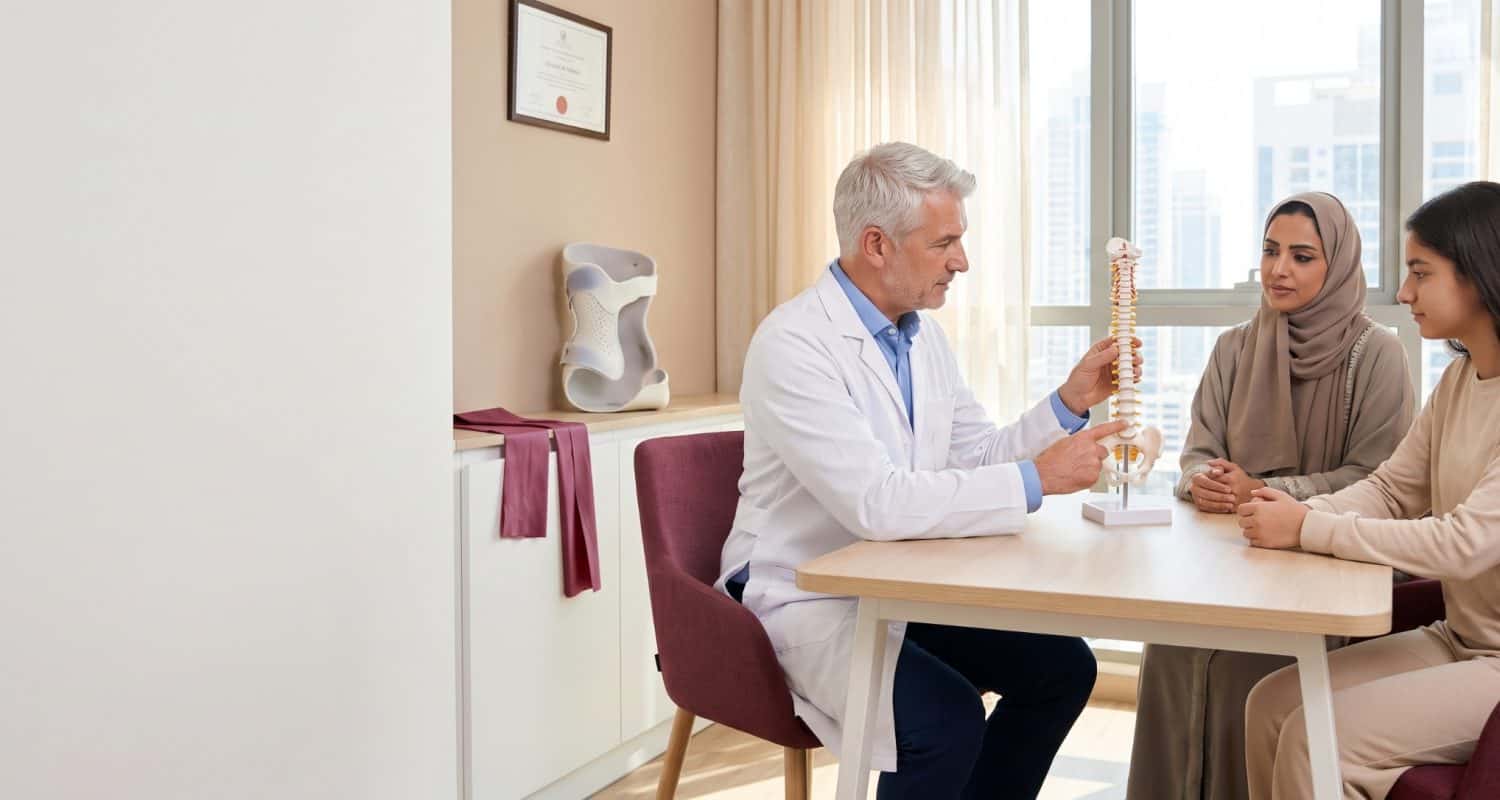
What to Expect During a Conservative Scoliosis Assessment
A comprehensive scoliosis consultation may include:
- Medical and growth history
The doctor will ask when changes were first noticed, whether scoliosis runs in the family and whether the child has recently experienced a growth spurt. - Physical examination
Shoulder level, waist symmetry, pelvic balance, trunk rotation and overall posture will be assessed. - Neurological examination
Muscle strength, sensation and reflexes may be checked to identify any unusual findings. - Imaging review
Standing spinal X-rays may be used to measure the Cobb angle and evaluate the curve pattern, spinal balance and skeletal maturity. - Progression-risk assessment
The doctor considers the child’s age, growth remaining, curve size and previous imaging. - Personalised treatment plan
The recommendation may include observation, a custom brace, scoliosis-specific physiotherapy or a combination of these options.
Conservative Scoliosis Care with Dr. Ziad Aljian
Dr. med. Ziad Aljian is a German Board-Certified Consultant Orthopaedic Spine Surgeon with more than 20 years of clinical and surgical experience.
His areas of expertise include paediatric spinal deformities, scoliosis and kyphosis, growth-preserving procedures, vertebral body tethering and complex spinal reconstruction.
For adolescents receiving conservative care, careful monitoring is important throughout growth. The objective is to identify progression early, determine whether bracing is appropriate, coordinate physiotherapy when indicated and modify the treatment plan as the child approaches skeletal maturity.
At Adam Vital Hospital, families receive an individualised assessment rather than a treatment decision based only on the Cobb angle. The child’s growth, curve pattern, physical development, daily routine and emotional wellbeing are considered together.