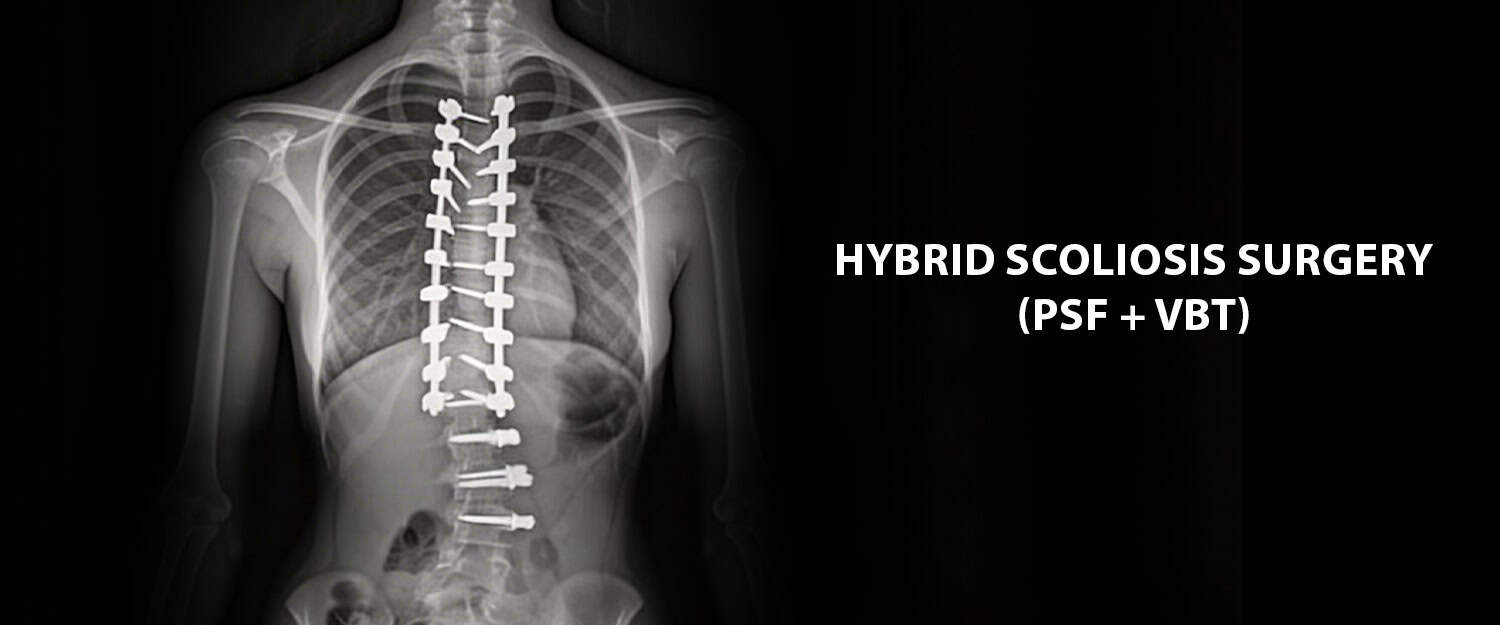
Hybrid Scoliosis Surgery (PSF + VBT): Combining Fusion and Motion-Preserving Correction in Dubai
Scoliosis presents a wide range of complexities, some curves are flexible and related to growth, while others are rigid or more intricate and require stronger stabilization. Consequently, treatment is not always a “one-size-fits-all” solution.
Hybrid Scoliosis Surgery refers to a carefully planned approach that combines two techniques in one overall strategy: Posterior Spinal Fusion (PSF) to stabilize selected segments, and Vertebral Body Tethering (VBT) to guide correction in other segments while aiming to preserve motion. This combined method may be considered for selected patients where both stability and flexibility are important goals.
When is Hybrid Scoliosis Surgery Considered?
Hybrid approaches to scoliosis surgery are generally considered when a single surgical technique may not provide the best combination of correction and mobility for a specific curvature pattern. This is most often discussed for Scoliosis in Adolescents who still have growth remaining, where preserving motion in selected segments may be an important goal. The decision to use a hybrid technique is highly personalized and depends on factors such as imaging results, flexibility testing, growth potential, and overall spinal alignment. This level of complexity requires a thorough, customized assessment by an experienced Scoliosis Specialist like Dr. med. Ziad Aljian to determine if a hybrid approach is the safest and most effective solution.
A Hybrid Strategy might be discussed in the following situations:
- Complex Scoliosis Patterns: When one area of the spine requires strong stabilization, while another area may benefit from a motion-preserving correction.
- Large or Structural Curves: In cases with a secondary curve that may be appropriate for tethering, depending on the individual situation.
- Preserving Motion: For patients where maintaining movement in certain segments of the spine is a primary goal.
- Selected Adolescents: Particularly those who still have growth potential, based on the type of curve and clinical evaluation.
- Optimizing Surgical Outcomes: When the surgical plan focuses on achieving balance, alignment, and long-term spinal function.
Hybrid Surgery vs. Posterior Spinal Fusion (PSF) Alone vs. Vertebral Body Tethering (VBT) Alone
Posterior Spinal Fusion (PSF) is the most established treatment for moderate to severe scoliosis. It corrects the spinal curve and stabilizes the spine using screws and rods, along with bone graft material to ensure the treated vertebrae fuse into a solid segment, providing long-term stability.
Vertebral Body Tethering (VBT) is a Minimally Invasive, Non-Fusion Technique designed for carefully selected growing patients. It utilizes anchors and a flexible tether placed along the side of the spinal curve to guide correction while aiming to preserve spinal motion.
Hybrid Surgery combines the principles of both PSF and VBT, employing PSF where stability is most critical and VBT in areas where motion preservation is advantageous. This approach is based on a thorough analysis of the individual spinal curve.
How Does Hybrid Scoliosis Surgery Work?
Hybrid Scoliosis Surgery is designed to address different components of the spinal curve. The surgeon carefully evaluates each part of the curve to determine which sections should be fused for stability and which can be treated with tethering. The main objectives of this approach are to:
- Improve Overall Spinal Alignment and Balance
- Provide Strong Stabilization in areas where the Curve is Rigid or Severely Affected
- Preserve Motion in Selected Segments where Tethering is appropriate
- Support Long-Term Function and Posture based on the Patient’s Goals and the Specific Characteristics of their Curve
The Hybrid Surgical Process
The Hybrid Scoliosis Surgery process begins with thorough pre-operative planning. Your Specialist will evaluate standing X-rays and may also request MRI or CT scans. Flexibility studies of the curve may be conducted to decide which segments are best suited for fusion versus tethering. The planning phase also includes obtaining medical clearance, conducting lab tests, and performing an anesthesia assessment.
What Happens During Surgery?
The specific steps of the procedure depend on the patient’s curve pattern, but a hybrid surgical approach may include the following:
- Posterior Spinal Fusion (PSF): This involves fusing selected levels of the spine using screws and rods to correct and stabilize the primary structural curve.
- Placement of Bone Graft: Bone graft material may be added to support the fusion process, as planned.
- Vertebral Body Tethering (VBT): This procedure may be performed on specific segments using anchors and a flexible tether to guide correction while aiming to preserve motion.
- Neuromonitoring: This technique is used to enhance safety during the correction process.
Your Scoliosis Specialist will discuss which levels of the Spine will undergo fusion and which ones will have tethering performed, as well as the reasoning behind this plan, considering the curve mechanics and treatment objectives.
Benefits of a Hybrid Approach
For carefully selected candidates, a hybrid strategy may provide the following advantages:
- A Balanced Approach that Supports Stability and Preserves Motion
- Strong Correction and Long-Term Stability in the Fused Segments
- Potential Preservation of Mobility in Tethered Segments, when appropriate
- An Individualized Plan Tailored to Complex Curve Patterns
- Improved Overall Posture and Spinal Balance Based on the Surgical Strategy
Recovery and Follow-Up: What to Expect
Recovery timelines can vary depending on the complexity of the curve, the number of levels treated, and the patient’s overall health. Generally, the recovery process may include:
- A hospital stay with early mobilization under supervision
- Pain Management and a gradual increase in activity
- Follow-up visits with repeat imaging to monitor alignment, fusion healing, and the performance of tethered segments
- A stepwise return to school, work, and routine activities based on the surgeon’s guidance
- Resumption of sports and higher-impact activities only after receiving clearance
Hybrid Procedures require careful follow-up, particularly to monitor tethered segments over time and ensure that overall balance is maintained as the patient grows or adapts.
Who May Be a Candidate for Hybrid Scoliosis Surgery in Dubai, UAE?
Hybrid Surgery may be considered for select patients who:
- Have scoliosis patterns in which different segments of the curve benefit from various correction strategies.
- Require strong stabilization in one area but wish to preserve motion in another area when appropriate.
- Have been evaluated and confirmed by a Scoliosis Specialist as suitable candidates based on imaging and clinical factors.
- Have goals that focus on both improving alignment and maintaining functional mobility.
Eligibility for Hybrid Surgery is highly individualized. A Comprehensive Spine Assessment is essential to determine whether Hybrid Treatment provides a meaningful advantage for a specific curve pattern.
Conclusion
Hybrid Scoliosis Surgery, which combines Posterior Spinal Fusion (PSF) and Vertebral Body Tethering (VBT), represents an advanced and personalized approach. This method merges the established Stability of Spinal Fusion with the Motion-Preserving objectives of Tethering, when appropriate for the patient. The surgical plan is tailored based on several factors, including curve mechanics, flexibility, growth potential, and the long-term functional goals of the patient.
At the Complex Spine & Scoliosis Center at Adam Vital Hospital in Al Garhoud, Dubai, we emphasize Personalized Evaluations for Scoliosis, Modern Surgical Planning, and Comprehensive Follow-up Care. This approach is designed to ensure safe correction and promote long-term positive outcomes.